Inventory data lives in silos
Raw materials, WIP, and finished goods sit under different teams. Excel sheets and ERP data don't match, account-versus-actual gaps only surface at month-end, and decisions always lag the real inventory state.
GSAI · 2026 · 05 · 0021
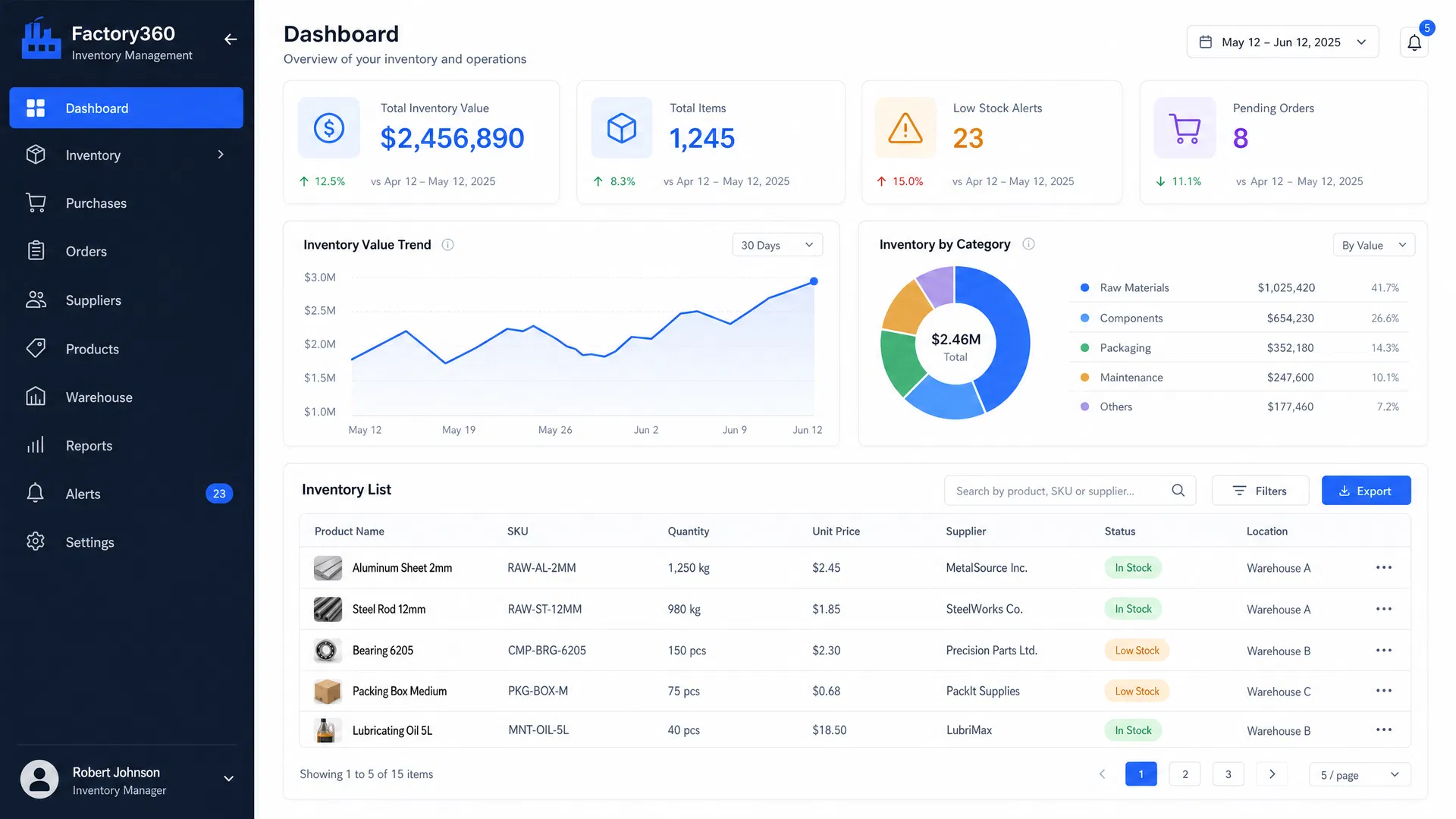
Factory Inventory SolutionCovers purchasing, sales, inventory, and finance — with AI-driven replenishment, demand forecasting, and anomaly detection on top. Multi-plant and multi-warehouse ready. Live in 12 weeks. Inventory turnover up 42% in 14 months.
Inventory cockpit
Inventory turnover
6.0 cycles/yr
0.08%
12,480
3 pending
Live
The customer is a mid-sized manufacturer with 3 production sites and 8 warehouses, around ¥280M in annual revenue. As they scaled, the Excel + basic-ERP setup couldn't keep up — data silos, broken processes, and decisions lagging actual inventory.
Raw materials, WIP, and finished goods sit under different teams. Excel sheets and ERP data don't match, account-versus-actual gaps only surface at month-end, and decisions always lag the real inventory state.
Procurement plans rely on senior staff intuition, with no automated suggestions based on sales forecasts or safety stock. The team swings between emergency stockouts that halt production and over-buying that ties up cash.
Warehouses still run on paper forms and manual cross-checks. Each receipt takes 3–4 forms, daily volume is 200+ transactions, and the error rate sits stubbornly around 1.2%.
Inventory data is disconnected from the finance system. Month-end takes 3 finance staff 5–7 working days, with constant re-checks from inconsistent definitions — and lingering audit risk.
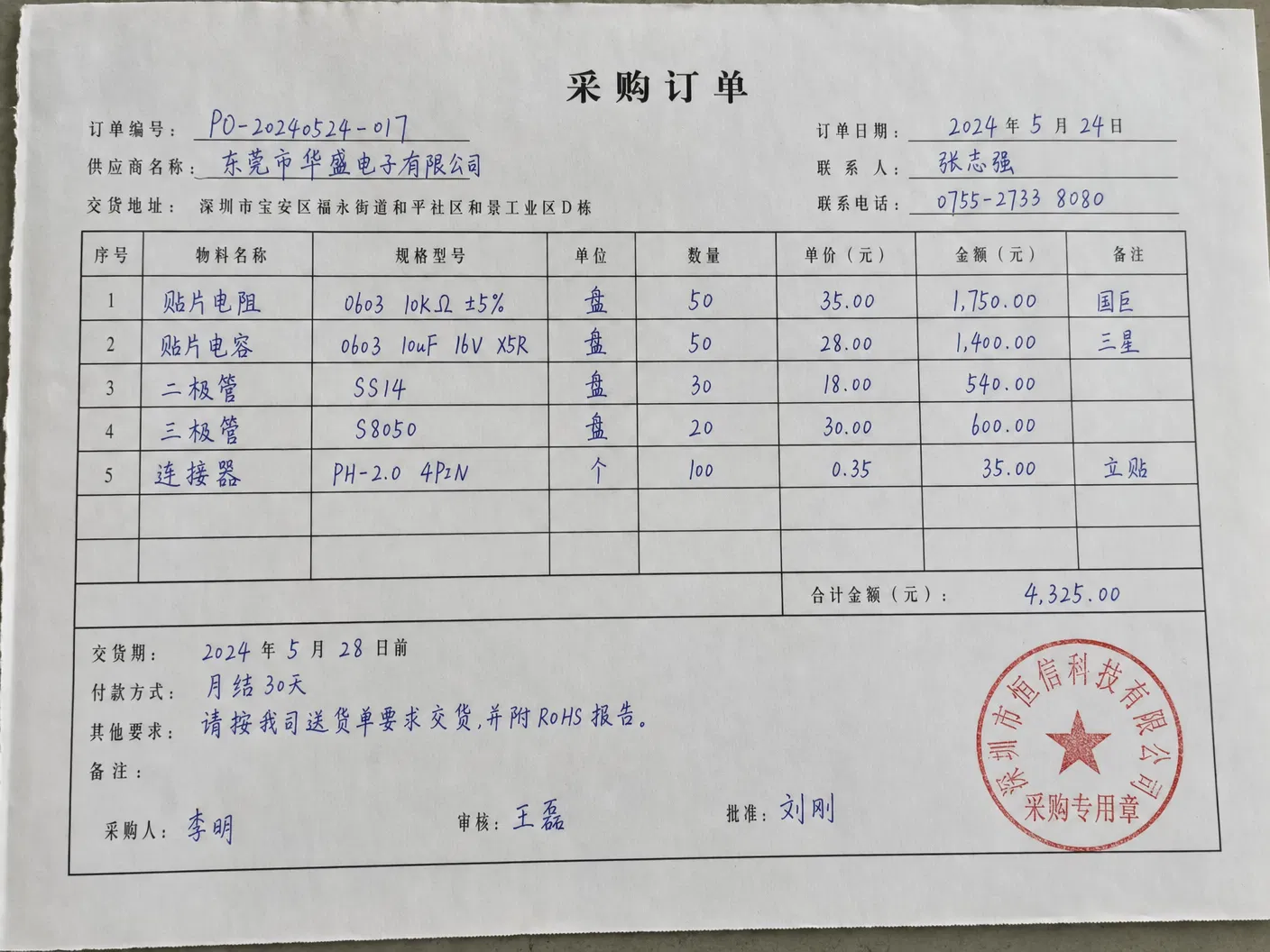
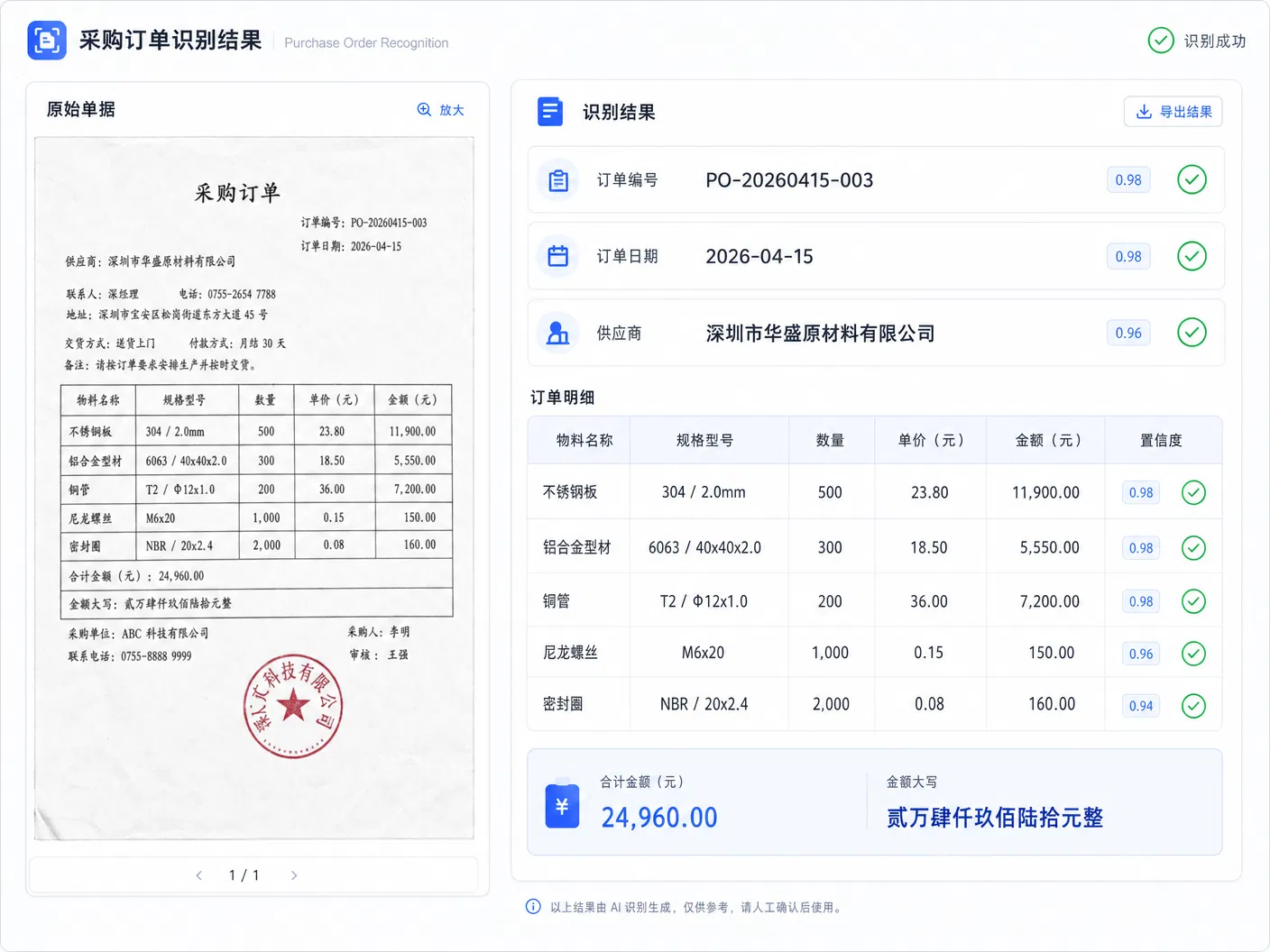
Below is a real handwritten purchase order from the customer's environment (sanitized). We show the original document, the AI recognition result, and the structured data that lands in the system — side by side — so you can see what the system actually does.

jpg · 1408×1056 · sanitized

Five different material specifications — the system auto-matches to standard SKU codes and verifies pricing ranges.
Line items sum to ¥24,960.00 — matches the total. Amount in words cross-checks numerals.
Messy handwritten supplier names auto-match against the supplier master record.

We don't lead with a product. After thorough discovery of the customer's org structure, workflows, and IT landscape, we systematically evaluated three candidate paths and picked the one that fit their stage.
Kingdee / Yonyou / Guanjiapo
Implementation
2–4 weeks
Flexibility
Low
Annual cost
¥30K–80K
SAP / Oracle / DingJie
Implementation
6–18 months
Flexibility
Medium
TCO
¥500K–2M
Wavesteam · GS-IMS v2
Implementation
8–12 weeks
Flexibility
High
Year-1 cost
¥150K–300K
What we delivered isn't off-the-shelf software — it's a custom inventory system that fits the customer's workflow, embeds AI-driven decisions, and stays flexible. Core purchasing, sales, and inventory modules are built by Wavesteam, sized exactly to multi-plant, multi-warehouse needs. AI modules handle replenishment suggestions, inventory alerts, and anomaly detection. A standard integration layer connects cleanly to existing ERP and finance systems. The result hits flexibility, cost, intelligence, and extensibility — all four at once.
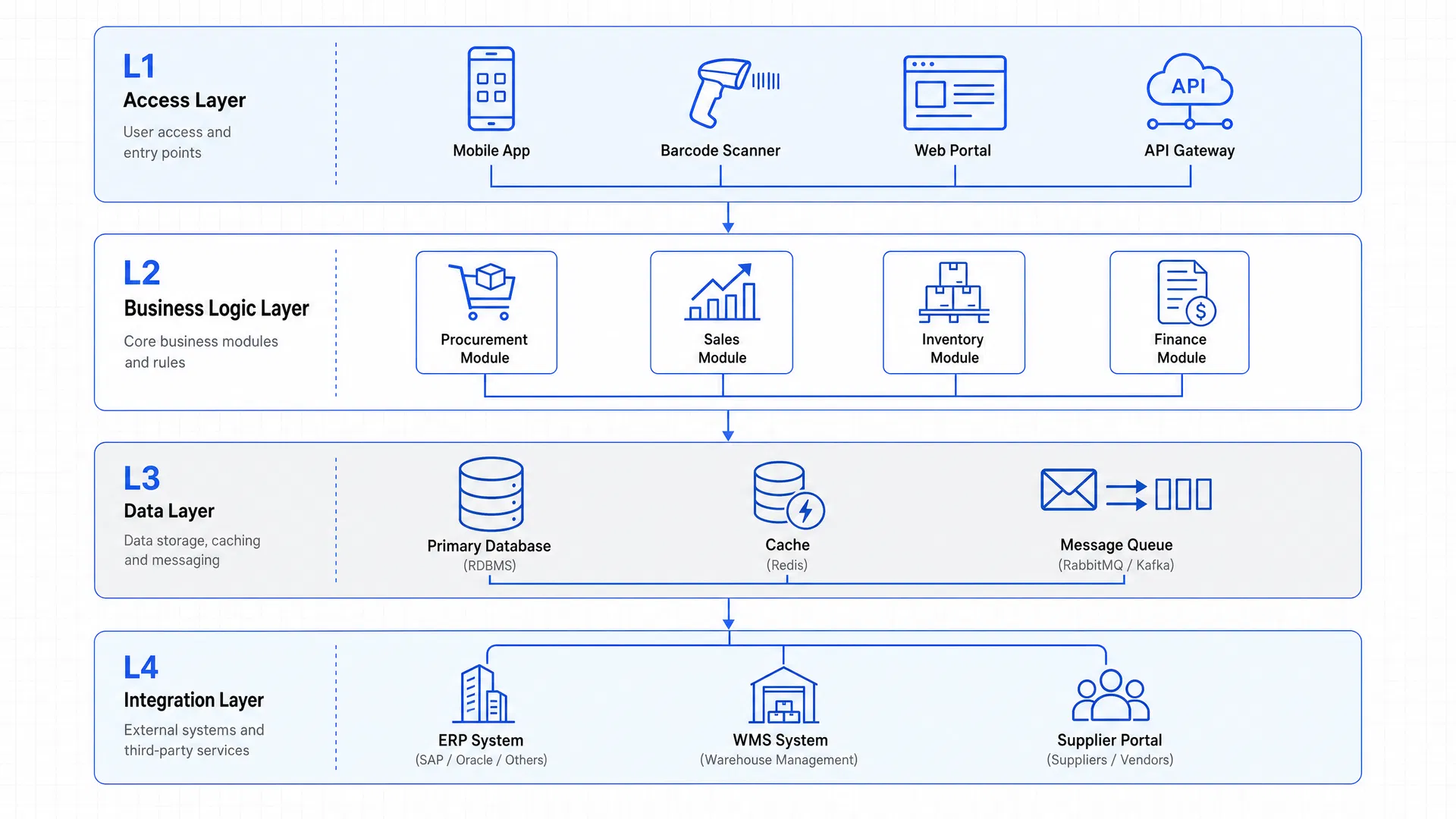
We treat inventory systems as engineering, not packaged software. Every layer has a clear responsibility, a clear interface, and a clear extension path. The five-stage business pipeline + four-layer system architecture below is the full technical backbone.
Capture business data across Web, mobile, barcode scanners, and APIs. Standardize material codes, supplier records, and units to eliminate source-side inconsistency.
Configurable workflow engine drives the full chain — purchase request → approval → order → receipt → check → stock-in — with multi-level approvals and exception branches.
Real-time tracking across warehouses and bin locations. Automatic replenishment suggestions and aging alerts based on safety stock, ABC classification, and historical consumption.
Forecasts 30/60/90-day material demand from historical sales and seasonality. Auto-generates purchase plan suggestions to support data-driven decisions.
Auto-generated inventory reports, finance reconciliation statements, and audit logs. Custom dashboards and data export — every transaction stays traceable.

Supports Web, mobile, barcode scanners, and APIs. Unified authentication, access control, and data masking.
Channel
Web admin console
Channel
Mobile app
Channel
Barcode scanner · Webhook
Gateway
API Gateway · JWT
Four core modules + workflow engine driving the full purchasing, sales, inventory, and finance flow.
Module
Purchasing
Module
Sales orders
Module
Inventory control
Module
Finance reconciliation
Machine learning–driven demand forecasting, smart replenishment, and anomaly detection — turning the system from a recorder into a decision assistant.
AI
Demand forecasting engine
AI
Smart replenishment
AI
Anomaly detection
AI
Supplier scoring
Unified storage, caching, and message queues — with standard interfaces to ERP, WMS, and finance systems.
Storage
PostgreSQL + Redis
Queue
Kafka message queue
Integration
ERP interface
Integration
WMS sync service
We break the project into 7 milestones. Each one has clear deliverables and acceptance criteria. The customer participates at every review checkpoint — keeping the solution tight to actual business needs.
Deep discovery across 3 factories and 5 departments — 12 business interviews, current-state diagnosis report, and requirements spec.
Deliverable
Requirements spec v1.0
Three technical paths evaluated. Selection report shared with the customer's leadership team. Final call: custom-built + AI-driven.
Deliverable
Selection report + review minutes
Build the three core modules — purchasing, inventory control, sales orders — plus the base data architecture and API layer.
Deliverable
Core modules alpha
Train the demand-forecasting model on 18 months of historical data. Integrate smart replenishment and inventory alerts. End-to-end integration test.
Deliverable
AI module + integration test report
Connect to the customer's existing ERP (Yonyou U8). Migrate 120K material master records and 360K historical transactions.
Deliverable
Data migration validation report
Three rounds of user acceptance testing covering 28 core business scenarios. Train 45 frontline operators on the system.
Deliverable
UAT sign-off + training manual
Formal cutover. Hand over operations docs. Begin a 3-month on-site support period.
Deliverable
Go-live confirmation + ops manual
Below are real operating statistics from 14 months after go-live. All metrics confirmed by the customer. We don't promise projected gains — we show what actually happened.
| Metric | Before | After | Change |
|---|---|---|---|
| Inventory turnover | 4.2 cycles/yr | 6.0 cycles/yr | +42% |
| Purchasing approval cycle | 5 days | 1.5 days | -70% |
| Receiving/shipping error rate | 1.2% | 0.08% | -93% |
| Month-end reconciliation | 5–7 days / 3 staff | 0.5 day / 1 staff | -90% |
| Tied-up inventory capital | ¥12M | ¥8.2M | -¥3.8M |
| Production stoppages from stockouts | 3.5/month | 0.2/month | -94% |
“The biggest immediate win: real-time inventory across every warehouse, in a single view. Before, checking stock meant calling three warehouse managers — now it's a phone screen away. Procurement says smart replenishment suggestions cut their repetitive work by at least half.”
Although this case comes from electronic components manufacturing, the architecture adapts cleanly to other industries. Below are validated deployments we've seen succeed.
High SKU count, complex specifications, fragmented supplier base. Supports material code auto-matching, substitute material management, and BOM-linked inventory consumption.
Multiple raw material categories with precise processing loss measurement. Supports batch traceability, automated loss-rate calculation, and scrap recycling management.
Shelf-life management is the core requirement. Enforces FIFO, surfaces near-expiry alerts, and supports batch recall traceability.
Strict customer delivery requirements and minimal inventory buffer under JIT. Supports kanban-pull replenishment and a supplier collaboration platform.
Front-end React / Vue, back-end Node.js / Python, databases PostgreSQL / Redis — from UI to deployment, all in one team.
Demand forecasting, anomaly detection, smart recommendations — embedded inside business workflows, not bolted on as a separate 'AI feature'.
Team members come from manufacturing ERP, MES, and WMS backgrounds. We understand the real pain on the factory floor — no forced 'internet thinking'.
Private-cloud deployment, encrypted data transport, full operation audit logs — meeting manufacturing customers' strict data and compliance requirements.
Related solutions
AI, capital-markets docs, OCR, vision, IoT and membership operations — composable for your industry.
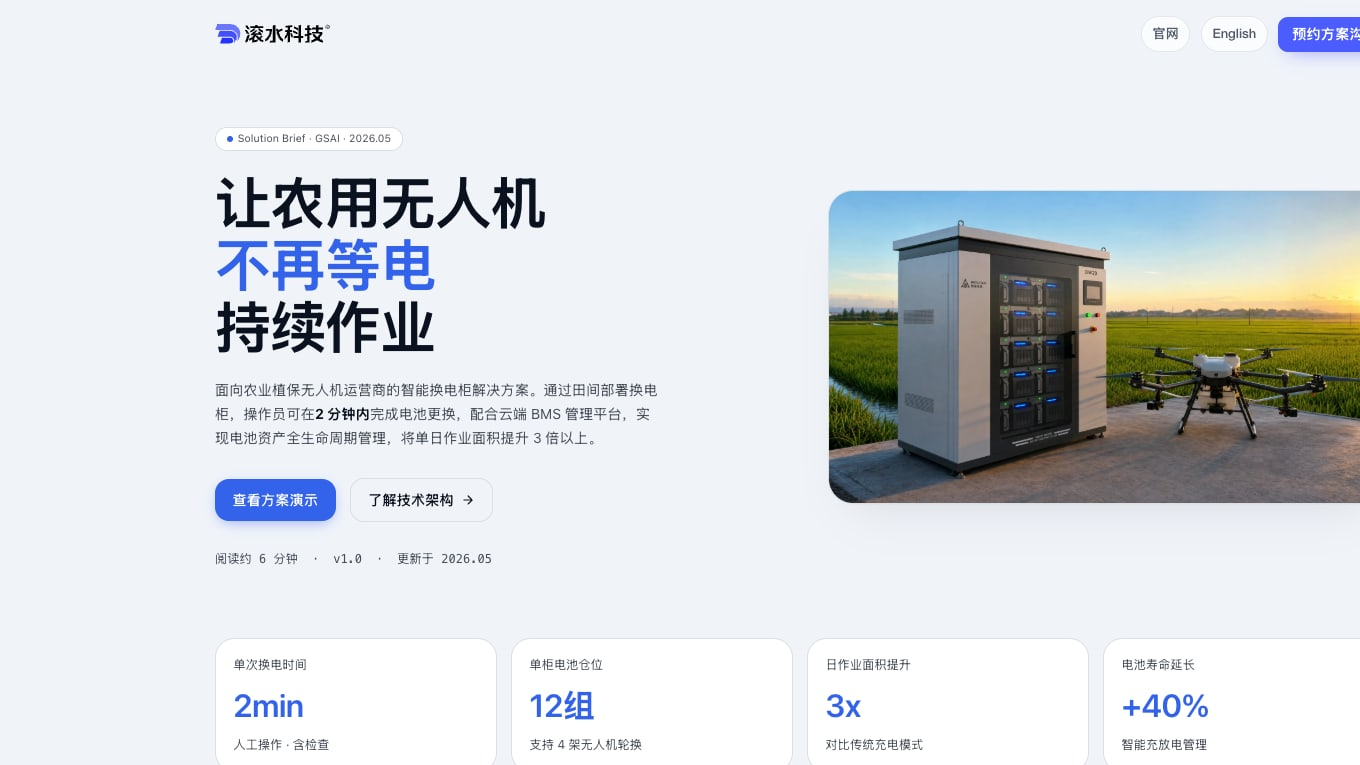
Field-deployable battery-swap cabinets with cloud BMS — 2-minute swaps, 12 bays per cabinet, 3× the daily area covered, and 8-month payback for ag-drone operators.
A pet wearable platform fusing IMU, temperature, and GPS — gentle daily health monitoring and real-time location with 14–21 day battery, IP67, and breed-agnostic accuracy.
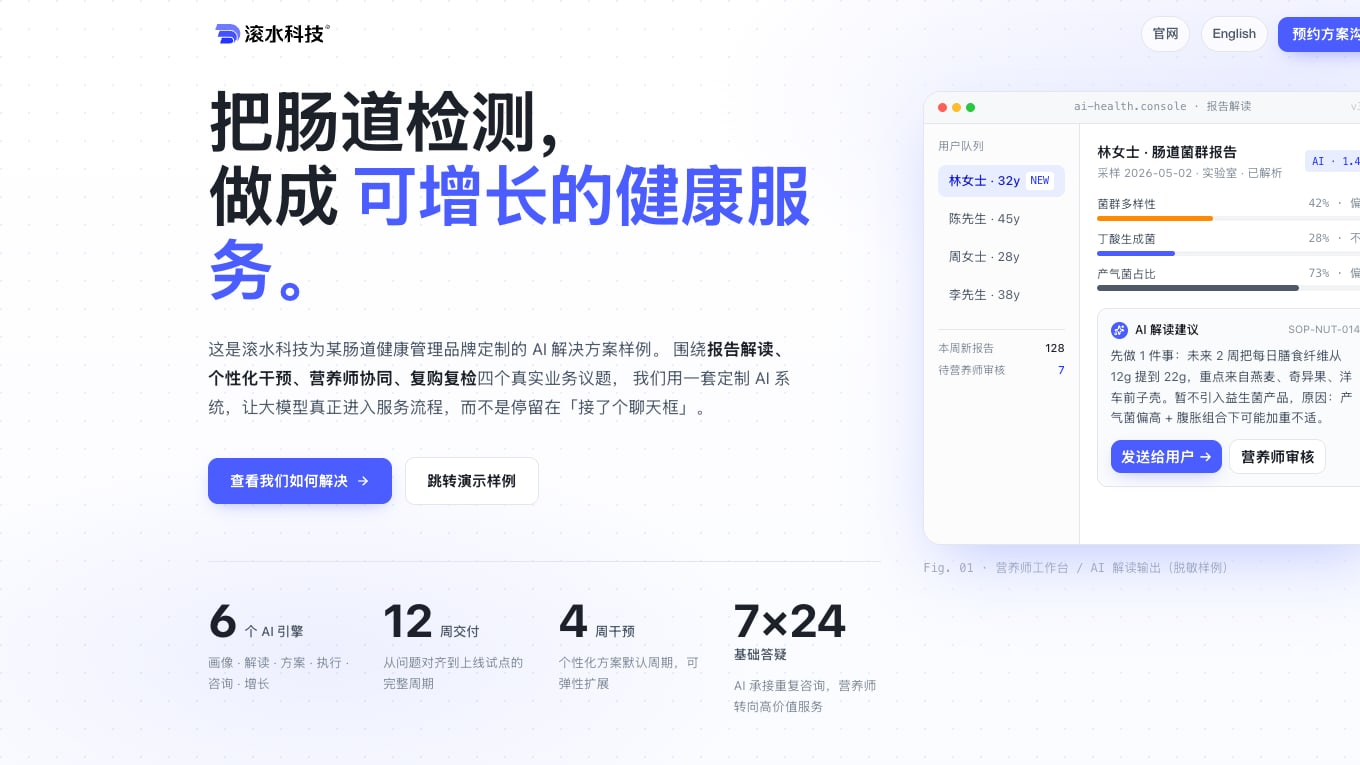
An operating system for AI health brands — gut testing, report interpretation, personalized intervention, nutritionist workflows, and a repeat-purchase loop in one platform.
We unpack the workflow with you, judge whether AI is worth using and which approach makes the most sense, then come back within 5 business days with a practical initial plan and estimate.